Counseling and Psychological Services (CAPS) provides free, confidential, short-term, solution-focused mental health services to currently enrolled CSN students. Students can receive up to six sessions of short-term, solution-focused counseling per academic year, in addition to an initial intake appointment. Counseling appointments are scheduled in advance, and students must complete the intake process before scheduling their first counseling appointment. Whether you're feeling overwhelmed, managing stress or anxiety, navigating a life transition, or simply need someone to talk to, CAPS is here to help. Our team provides a safe, supportive space where students can receive the support they need to thrive both academically and personally.
- Free for currently enrolled students
- Confidential & voluntary
- In-person and virtual appointments available

Faculty and Staff: If you are concerned about a student, encourage them to contact CAPS directly and, if appropriate, offer to help them make the call or send the email. Because CAPS services are confidential and voluntary, students must initiate services themselves.
Clinical contact with students is privileged and confidential under Nevada State Law, the Family Education Rights and Privacy Act (FERPA), and in accordance with the Ethics Code (2003) of the American Psychological Association.
Information about a student involvement with CAPS will only be released if the student signs a written Release of Information authorizing the disclosure of such information identifying to whom information should be released.
Legal Exceptions
Legal exceptions to confidentiality, in accordance with Nevada State Law, exist when:
- There is a need to protect against a clear & substantial risk of imminent serious harm to self or others.
- There is reasonable concern of abuse or neglect of a child or vulnerable adult.
- There is a court order for release of information.
HOW TO CONNECT
At CAPS, we make it simple to get support and start your mental health journey.
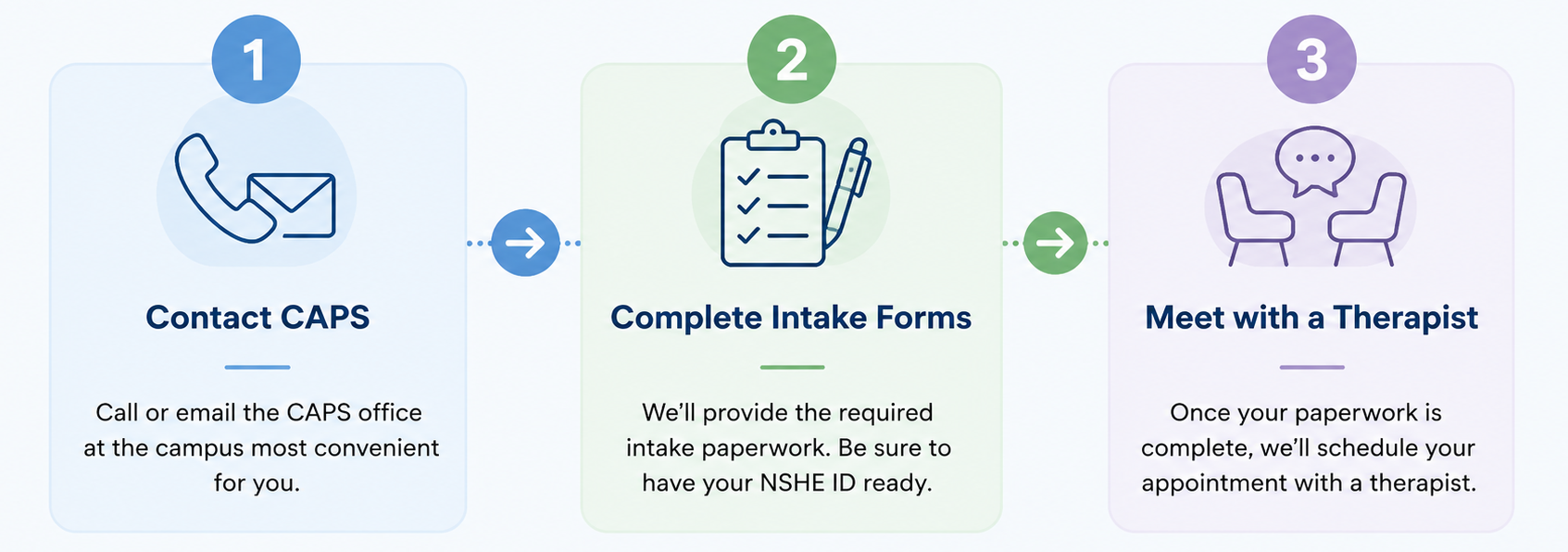
Step 1: Contact CAPS
Call, email, or visit the CAPS office at the campus most convenient for you. Be sure to have your NSHE ID number available when you contact us.
Charleston Campus | North Las Vegas Campus | Henderson Campus |
Step 2: Complete Your Intake Paperwork
After making contact, a member of our administrative team will help you get started with the intake process by providing the required paperwork (Request for Service and Initial Intake Form).
Step 3: Meet with a Therapist
Once your paperwork is complete, you can schedule an appointment with one of our licensed mental health professionals! For your convenience, our clinicians are available in-person or virtually.
MEET THE TEAM
Our licensed counselors and mental health professionals are here to support you in a welcoming, inclusive environment.
Mental Health Tools for You
CAPS offers free access to digital mental health tools to support you anytime, anywhere.
- Togetherall: An anonymous online community where you can share, connect, and access self-help resources.
- aiberry: A self-guided mental wellness screening tool that helps you better understand your emotional health.
CAPS offers free mental health trainings for students, faculty, and staff to help recognize when someone may need support and connect them to care early. We offer one in-person (Mental Health First Aid) and one online program (LivingWorks Start), both of which provide certificates. For registration information regarding Mental Health First Aid or LivingWorks Start, please email MentalHealth.FirstAid@csn.edu.
If a student is in immediate danger to self and/or others, contact CSN Campus Police (702-651-7911) or local emergency services (9-911) immediately.
If you or someone you know is experiencing a mental health emergency, help is available 24/7. Call or text 988 to reach the Suicide & Crisis Lifeline, or chat via 988lifeline.org.
The Mental Health 360 Conference: Knowledge, Self-Care & Transformation took place on the North Las Vegas Campus on April 14, 2023. The conference brought together leading mental health researchers, clinicians, faculty, students and advocates to share practical advice and raise awareness on the warning signs and treatment options that can support individuals affected by mental illness. The conference’s workshops were based on the following five tracks: Crisis & Trauma, Diagnosis & Treatment, Student Needs, Legal Concerns and Diversity in Mental Health.
Mental Health 360 Conference highlights
Mental Health 360 Resource Guide
Recursos de salud mental disponibles en Español
Funding for this conference was made possible (in part) by the Substance Abuse and Mental Health Services Administration (SAMHSA). The views expressed in written conference materials or publications and by speakers and moderators do not necessarily reflect the official policies of the U.S. Department of Health and Human Services, nor does the mention of trade names, commercial practice or organizations imply endorsement by the U.S. Government.