Office of Institutional Effectiveness, Accreditation, and Strategic Planning Mission:
The Office of Institutional Effectiveness, Accreditation, and Strategic Planning promotes the use of quality planning and measurement practices to assure institution and student success.
Institutional assessment occurs through:
- strategic plan indicators,
- unit plan effectiveness indicators,
- student learning outcome achievement benchmarks, and
- evidence-based actions for improvement.
The Director facilitates institutional assessment by:
- Leading, supporting, and coordinating planning, assessment and evaluation, and improvement efforts at the campus, unit, and program levels
- Documenting evidence of performance targets, metrics, and benchmarks
- Reporting to internal and external stakeholders on student learning outcomes achievement, goal performance indicators, and program effectiveness at the campus, unit, and program levels.
The office has implemented a seven-step model to guide assessment and improvement across all institution programs, units, and services. The overarching focus across system units is a motto of Students First and Assurance of Student Learning.

All CSN campuses, units, services, and programs contribute to institutional effectiveness by participating in a regular system of assessment planning and reporting of data collected through direct and indirect measures of student learning, performance activities, or service delivery. CSN uses a regular assessment system to collect, analyze, and evaluate data for achievement of outcomes, unit goals, and activities. Documented evidence is used for decision-making in planning and budget request processes.
CSN participates in an integrated strategic planning system where all unit goals align with the CSN strategic plan and Nevada System of Higher Education (NSHE) strategic goals. Assessment evidence is used to inform decision-making, improvement actions, resource allocation, and determine mission fulfillment. The assessment system is divided into four data collection units: Academic Affairs, Academic Support, Student Support, and Institutional Support. All units report evidence supporting achievement of strategic plan and institutional effectiveness indicators leading to CSN mission fulfillment. CSN units are expected to align their assessment processes with two core guiding structures in higher education: the four essential learning outcomes of the American Association of Colleges and Universities Liberal Arts for America's Promise (LEAP) Initiative, and six standards and learning outcome domains of the Council for the Advancement of Standards (CAS) in Higher Education.
Related Links:
Questions about institutional assessment processes can be directed to:
Sharon "Shari" Peterson, PhD, RDH
Accreditation Liaison Officer and Director - Office of Institutional Effectiveness, Accreditation and Strategic Planning
6375 W. Charleston Blvd. WC E306
Las Vegas, NV 89146
(702) 651-7784
Contact Us

Institutional Assessment
SPRING 2026
- All program learning outcomes and their assessment measures have been programmed in Watermark. Lead faculty have been assigned to each program area who have the responsibility of updating assessment plans and entering assessment reporting information. Each of those faculty have been provided an Assessment Reporting Handbook and training on how to complete and submit annual reports. To simplify reporting, over 50% of the assessment lead faculty have opted into Watermark automated data collection from Canvas.
- Beginning July 1, 2026 the annual reporting cycle will be from July 1 - June 30. No assessment reporting will be due November 1, 2026 as we transition to a new assessment timeframe. Faculty can collect data and report on Program and course learning outcome achievement anytime during the assessment cycle. We highly encourage faculty to collect data in the fall semester, then collaborate with faculty to analyze the data, determine actions for improvement, and then complete reports on learning outcomes in the spring semester prior to faculty going off contract in May.
- This spring we will be asking programs to complete or update their 6-year assessment plans to include which courses will be evaluated and reported each year. We will use the assessment plans to program those courses in Watermark each year with the course SLOs and assessment measures. We recommend programs evaluate and report 2-3 courses in the discipline each year.
- The office will work this spring with the lead faculty to set up mapping of course and program learning outcomes to institutional learning outcomes (ILO) in Watermark.
- We encourage faculty to participate in the Faculty Senate Assessment Committee ILO Assessment Project. To learn more and participate in the project, click on ILO Assessment Project in the next accordion below.
At CSN, assessment of student learning occurs at the course, program major, and institution levels.
| Assessment Timeline | Institutional Learning Outcome (ILO) Assessment | Program & Course Level Assessment | Resources & Training |
|---|---|---|---|
| Academic Assessment Planning and Reporting Timeline | Institutional Learning Outcomes and Measurement Rubrics | Watermark PSS Assessment Reporting Guide | Resources |
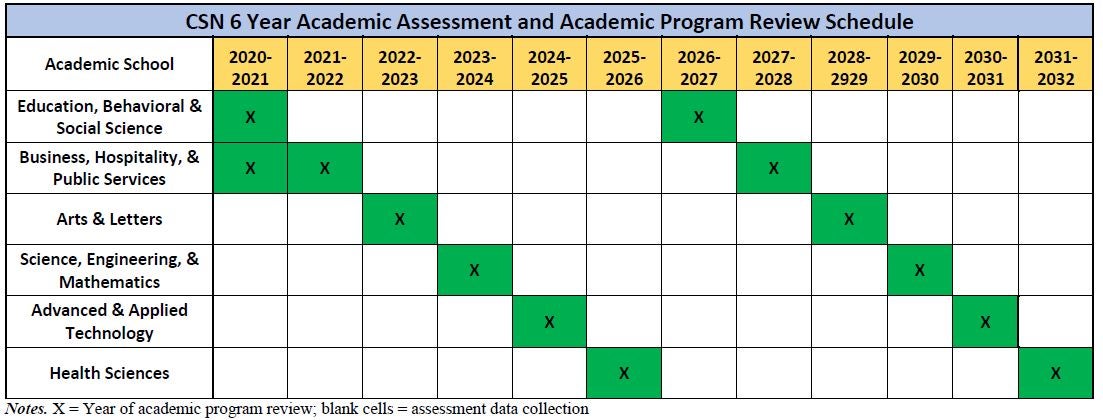
| 6-Year Assessment Planning and Academic Program Review Cycle | Reference Guide for ILO Assessment Project | Link to automate PLO or SLO assessment data collection within Canvas | CSN Glossary of Terms |
| 2024 Pilot ILO Assessment Project Results | Academic Assessment Planning and Reporting ARCHIVE | American Association of Colleges and Universities (AAC&U) Professional Development | |
| 2024 Pilot ILO Rubric Analysis | |||
| Link to participate in ILO Assessment Project |
CSN has implemented unit planning for all executive, institutional support, student support, academic support, and academic units (Schools and Departments). Unit planning components consist of a unit mission, SMART goals, strategies, effectiveness measures, and action items. Unit planning is updated annually and modified as necessary, based on assessment evidence from the previous academic year. The planning and reporting timeline below should be followed with an annual reporting due date of November 1 for data collected the previous fiscal year.

Annually the CSN president in conjunction with the Office of Institutional Assessment and Accreditation conducts an informal review of unit plans using "show-n-tell" (SNT) presentations from each unit plan manager. The synergistic experience allows collaboration within and across units to communicate priorities and partnership opportunities. As CSN evolves in our unit plan process, we are working on a formal unit plan review every six years, to retrospectively evaluate the effectiveness, adequacy, and efficiency of unit goals and our process.
All unit plans are published for college-wide viewing in the Unit Planning segment below.
Integrated Strategic Planning | Unit Planning | Unit Plan Training |
| Integrated Strategic Planning Policy | Plans and Reports |
Year of Review | Academic Program Review |
| 2018-2019 | School of Health Science (archived) |
| 2019-2020 | |
| 2020-2021 | |
| 2021-2022 | Department of Business |
| 2022-2023 | School of Arts and Letters |
| 2023-2024 | School of Science, Engineering, & Mathematics |
| 2024-2025 | School of Advanced & Applied Technology |
| 2025-2026 | School of Health Sciences |
| 2026-2027 | School of Education, Behavioral, & Social Science |
| 2027-2028 | School of Business, Hospitality, & Public Services |
| 2028-2029 | School of Arts and Letters |
| 2029-2030 | School of Science, Engineering, & Mathematics |